
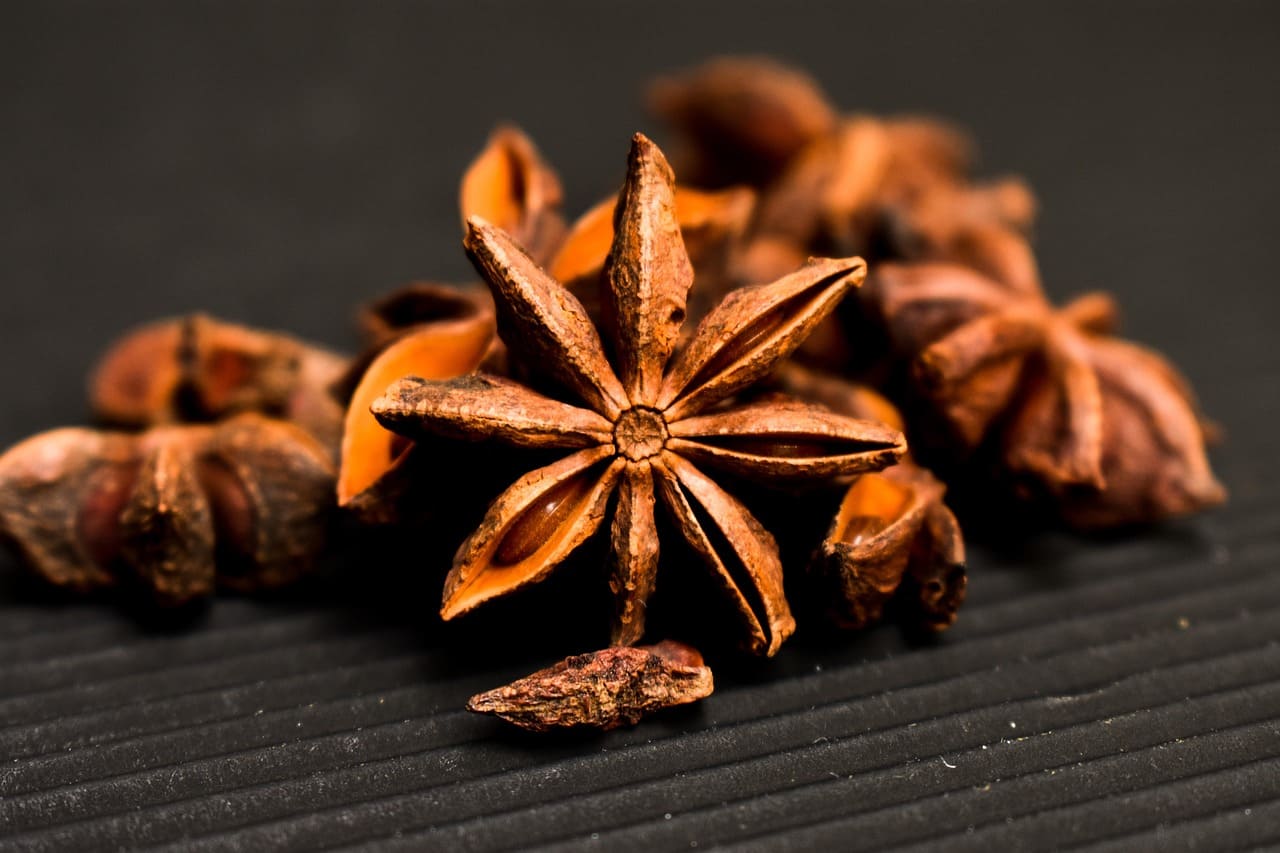
My grandmother kept star anise pods in a jar above her stove, wedged between the cinnamon sticks and a bottle of fish sauce. As a kid I thought they were decorative — those eight-pointed brown stars, each one almost geometrically perfect. Then she dropped one into a pot of simmering pork broth and the whole kitchen shifted. Sweet, warm, a little dark. Nothing else smells quite like it.
That’s the thing about chinese star anise. The visual is striking, but the real argument is the aroma. One pod in a pot and you understand immediately why this spice has been traded, prescribed, and cooked with for over two thousand years. It’s not subtle, and it doesn’t need to be.
What Star Anise Actually Is
Despite the name, chinese anise has no botanical relationship to European anise (Pimpinella anisum). They share a flavor profile — that forward, licorice-like warmth — because both are high in anethole, the same essential oil compound. That’s where the similarity ends. They come from different plant families, different continents, and have distinct culinary histories.
A star anise pod is the dried fruit of illicium verum, a small evergreen tree native to the Guangxi province of Southwest China and the neighboring regions of northern Vietnam. The tree produces star-shaped pods — typically eight points, each holding one glossy seed. Both the pod and the seed are used: dried whole for broths and braises, ground for spice blends, or distilled into essential oil for flavoring and cosmetics.
One thing worth knowing before you buy: Japanese star anise (Illicium anisatum) looks almost identical to illicium verum but is toxic and not edible. The two are easy to confuse when buying whole pods from unfamiliar sources. Stick to reputable spice suppliers and look for the botanical name on the label. This is one of the rare cases where the sourcing genuinely matters for safety, not just quality.
The Flavor: Warmer and More Complex Than Licorice
Star anise smells like licorice but tastes more layered than that single comparison suggests. There’s sweetness upfront, then a dry warmth, a faint earthiness, and a slightly bitter finish that stops the flavor from reading as candy. It’s a spice that works equally well in a braised pork belly and a spiced Christmas cookie without feeling out of place in either — which is a harder trick than it sounds.
How the flavor behaves depends heavily on the application:
- In braised meats, it rounds out and deepens the savory base in a way that’s hard to replicate with anything else
- In broths and soups, a single whole pod infuses the liquid with fragrance without taking over the other ingredients
- In baking, ground chinese anise contributes to the warm spice profile of holiday cookies, cakes, and breads alongside cinnamon and cloves
- In mulled wine and cider, the whole pod releases its oils slowly into hot liquid — it’s largely responsible for the scent most people associate with winter kitchens
The most useful rule of thumb: treat a star anise pod the way you’d treat a bay leaf. It’s a background note, not a foreground ingredient. Add one to the pot, let it do its work, and pull it out before you serve. Start with one. You can always add another next time; you can’t un-anise a dish.
Where Star Anise Shows Up in Global Cooking
Chinese star anise is probably most familiar to Western cooks as a component of Chinese five-spice powder — the blend of star anise, cloves, fennel seeds, cinnamon, and Sichuan peppercorns that forms the aromatic base of Cantonese roast duck, Shanghainese red-braised pork, and countless other dishes where deep, layered fragrance is half the point.
Vietnamese pho relies on it heavily. A proper pho broth uses whole star anise pods alongside cinnamon and charred ginger, slow-simmered for hours. You can smell the anise from across the restaurant before the bowl reaches the table. That’s not an accident — it’s structural to the dish.
In Indian cooking, a chinese anise pod goes into hot oil at the start of biryanis and some curries, blooming in heat before the other aromatics follow. In German and Scandinavian baking traditions, it appears in spiced cookies and holiday breads where its edge gives the sweetness somewhere to go.
The pattern across all of these is consistent: star anise rarely stars. It supports. It rounds. It’s the note you don’t consciously identify but would notice immediately if it were missing.
Star Anise in Traditional Medicine and Herbal Wellness
Illicium verum has been used in Chinese traditional medicine for at least two thousand years — primarily for digestive complaints, respiratory congestion, and as a warming herb in cold-weather formulas. The compound most studied in modern contexts is shikimic acid, which occurs in the pods at high enough concentrations that they became the primary source material for synthesizing oseltamivir (Tamiflu) before alternative production methods were developed. That’s not a folk remedy claim; it’s documented pharmaceutical history.
In herbal tea practice, a single star anise pod steeped for 8 to 10 minutes makes a naturally sweet, fragrant tisane that most people find easy to drink without added sugar. It pairs cleanly with ginger for digestive warmth, and with medium skullcap — Scutellaria lateriflora, the American skullcap used traditionally as a mild nervous system relaxant — for an evening blend that combines the anise’s settling quality with skullcap’s calming effect. The combination isn’t from any single traditional system, but it works practically: the anise handles flavor and digestion, the medium skullcap handles the wind-down, and together they make a bedtime tea that actually tastes good.
Worth saying plainly: star anise is a spice with a documented traditional history and some genuine pharmacological interest. It’s not a treatment for anything. Use it because it tastes good and because centuries of cooks and herbalists found it worth keeping on the shelf. Whatever incidental wellness benefit comes with that is a bonus, not the point.
How to Buy, Store, and Use Star Anise Well
Whole pods hold their potency significantly longer than pre-ground powder. Stored in an airtight container away from light and heat, whole chinese star anise keeps well for two to three years. Ground star anise loses its aromatics noticeably faster — most of its character is gone within six to twelve months. Unless you’re using ground spice quickly and regularly, whole pods are the smarter purchase on both quality and economy.
Practical uses worth trying:
- Add one whole pod to any broth, soup, or braising liquid and remove before serving
- Drop into mulled wine or cider alongside cinnamon sticks, cloves, and orange peel
- Steep one pod in just-boiled water for 8 to 10 minutes for a simple digestive tea
- Grind whole pods fresh for five-spice powder — the difference versus pre-ground is immediate and the effort is about thirty seconds with a spice grinder
- Combine with medium skullcap, fresh ginger, and a cinnamon stick for a warming evening tisane
My grandmother never measured. She’d hold a pod up, smell it, and drop it in — and whatever she was making was better for it. Years of cooking with illicium verum will get you to that point. Until then, one pod per pot is the right starting place for almost every savory application, and half a pod for most teas. The rest is just practice.