
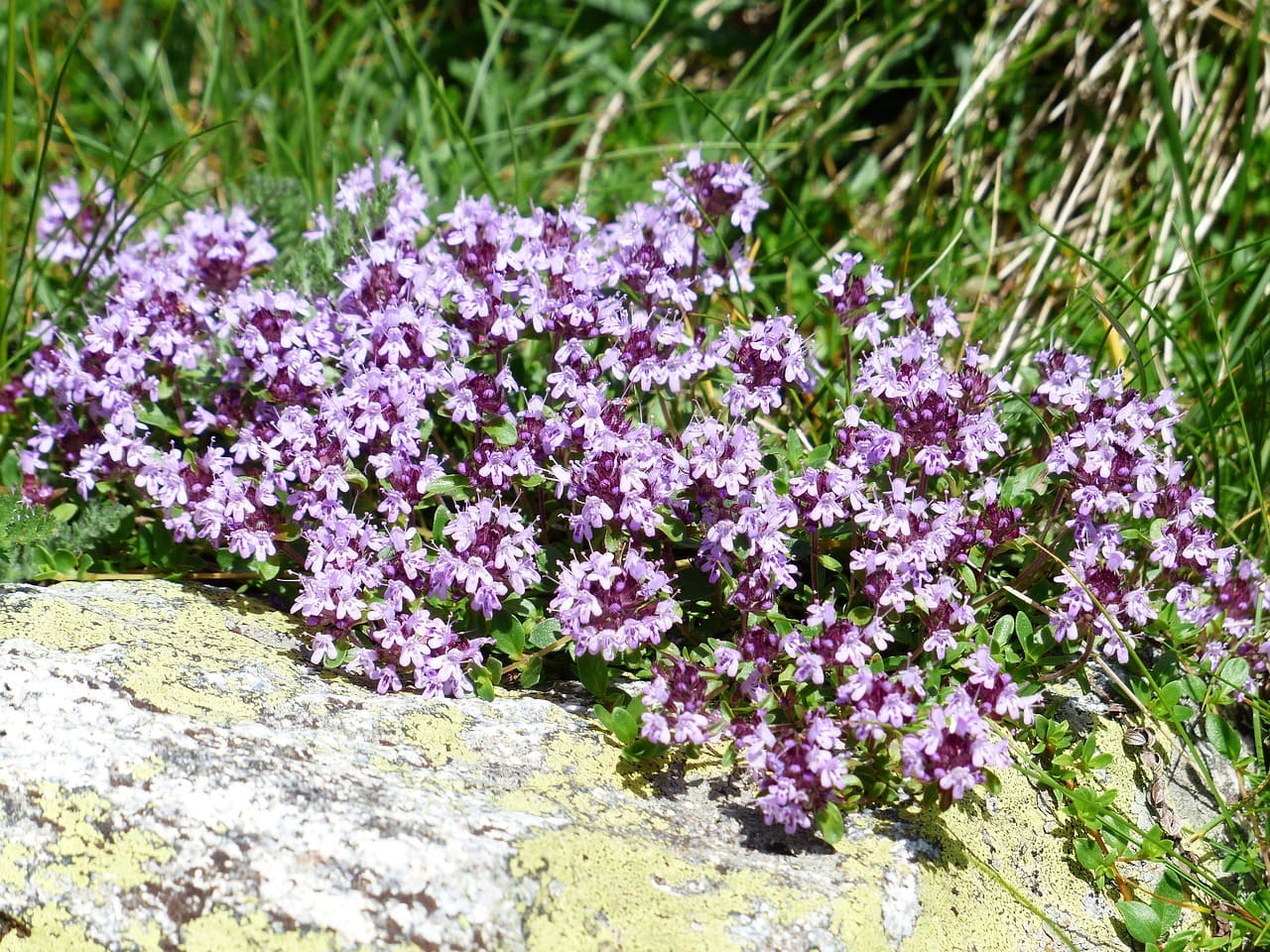
My neighbor Rob spent two summers losing a battle with a patch of bare clay beside his driveway. Grass died. Mulch slid down the slope. A ground cover sedum lasted one winter and gave up. A garden centre employee eventually handed him a tray of red creeping thyme and told him to plant it twelve inches apart, water it a few times, and leave it alone. Rob was skeptical. The following summer the entire slope was covered in dense dark foliage with crimson flowers. He hasn’t thought about that slope since.
That’s the thing about creeping thyme. It earns loyalty by solving problems other plants won’t touch. Drought, poor soil, awkward slopes, gaps between paving stones, light foot traffic — it handles all of it while smelling good and coming back every year. There aren’t many plants doing that combination reliably.
What Creeping Thyme Is and How It Differs from Common Thyme
Creeping thyme refers primarily to two low-growing Thymus species: Thymus serpyllum (wild thyme) and Thymus praecox (mother of thyme), along with their cultivated varieties. These are different plants from common culinary thyme (Thymus vulgaris), which grows upright as a shrubby bush. Creeping thyme spreads laterally, growing 2 to 4 inches tall and forming a dense, woody mat that roots where it touches the ground.
The flavor of the creeping thyme herb is similar to upright thyme but softer and slightly more floral — the same earthy warmth with less intensity. That difference matters both in cooking and in herb teas, where the milder profile is actually an advantage. It’s genuinely evergreen in most temperate climates, holds its foliage through winter, and flowers in late spring to early summer for several weeks.
The key practical distinction from upright thyme: creeping thyme is a ground cover first and a culinary herb second. Upright thyme is the reverse. Both roles are real — the creeping habit just changes the growing situation entirely.
Which Variety to Choose
Red creeping thyme (Thymus serpyllum ‘Coccineus’) is what most people picture and what Rob planted. It produces deep magenta to crimson flowers that cover the foliage almost entirely at peak bloom — the visual effect is substantial enough that it reads as intentional planting rather than a practical fix, even when that’s exactly what it is. It’s also the most vigorous and the most forgiving of difficult conditions, which makes it the default recommendation for anyone starting out.
Other varieties with distinct uses:
- Thymus serpyllum ‘Albus’ — white flowers, slightly less vigorous; better for formal or mixed plantings where the red variety’s intensity would dominate
- Thymus serpyllum ‘Pink Chintz’ — soft pink flowers, woolly grey-green foliage, slower spreading; more ornamental, less aggressive
- Thymus praecox ‘Elfin’ — compact and slow-growing, forming tight mounds rather than spreading mats; the right choice for between paving stones where you want cover without spread
- Lemon creeping thyme (Thymus serpyllum ‘Lemon Curd’) — citrus-forward fragrance, lighter foliage; the most useful culinary variety where you want the lemon note for fish, chicken, or summer vegetables
If you’re solving a landscaping problem and aren’t sure which to choose, start with red creeping thyme. It’s the most reliable performer across difficult conditions and the most visually rewarding at scale.
How to Grow Creeping Thyme Ground Cover
Two conditions matter above all others: full sun and good drainage. Creeping thyme ground cover handles drought, poor soil, and rocky ground better than most plants. It does not handle waterlogged or clay-heavy ground, where it will rot at the roots regardless of how otherwise tough it is. If drainage is the challenge — as it was for Rob — address it before planting or raise the bed slightly. Everything else this plant needs is minimal.
Practical guidance:
- Plant 12 to 18 inches apart — they fill in within one to two seasons; closer spacing gives faster cover at higher cost
- Water regularly the first season to establish roots; after that, natural rainfall handles most temperate climates
- Trim lightly after flowering to keep the mat dense and prevent the center from going woody
- Skip nitrogen-heavy fertilizers — they push leafy growth at the expense of the aromatic oils that give the plant its fragrance and flavor
- Light foot traffic is fine; heavy or repeated traffic in the same spot will thin the mat over time
Starting from creeping thyme seeds is the most affordable route but requires patience. Germination is slow, seedlings are small, and coverage takes longer. Starter plants are a better investment for most ground cover applications where you want results within a season or two. Seeds make sense if you’re covering a large area on a limited budget, or if you want to grow multiple varieties to compare.
Cooking With Creeping Thyme Herb
The creeping thyme herb is more useful in the kitchen than its ornamental reputation suggests. Strip the small leaves from the stems — they come off easily by running your fingers backward along the stem — and use fresh or dried. The flavor is softer and slightly more floral than common culinary thyme, which makes it better suited to lighter applications where upright thyme can be too assertive.
It works well in roasted vegetables, herb oils, simple tomato sauces, and braised chicken. The lemon creeping thyme variety is particularly good with fish and summer grain salads where you want citrus and herb without using two separate ingredients.
In fresh herb combinations, creeping thyme pairs usefully with cilantro (Coriandrum sativum) in a way that common thyme doesn’t. Cilantro’s forward citrus and faint soapiness needs something earthy and warm to balance it; creeping thyme provides that without the intensity that would make upright thyme fight the cilantro rather than complement it. The combination works in marinades for lamb or chicken, in chimichurri-style sauces, and in grain salads. Use roughly equal amounts of each by volume and adjust from there.
Rob discovered this when he started harvesting from the slope he’d planted for drainage reasons. He now grows it for both purposes without distinguishing between them. That dual use — ground cover problem solved, herb supply established, zero additional effort — is the most straightforward argument for planting creeping thyme over any alternative that only does one of those things.